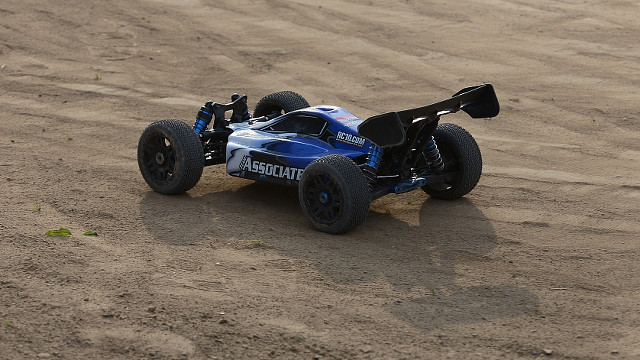
This Associated RC8.2e has seen the most track time of all of Team SKYFALL's vehicles. This model was the reason I have gotten into this hobby to the degree that I have. The upgrades that come on the Factory Team edition are well worth the cost, but nevertheless this is a competitively quick ready-to-run model that can be caught for as low as about $500 for the car itself (electronics included). If one does pick one of these up for themselves, here are the first things I recommend upgrading:
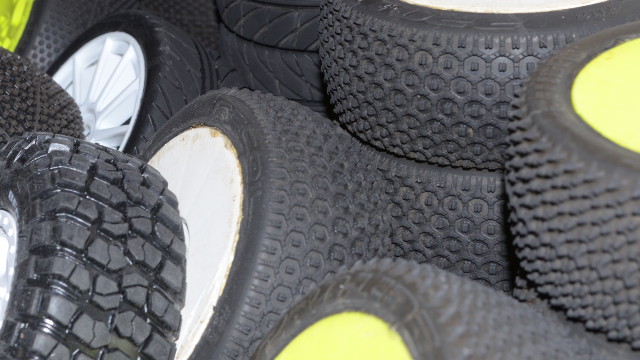
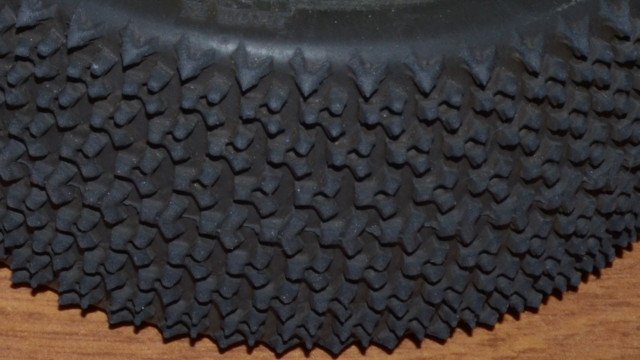
Tires. This is singularly the most important upgrade you can do for a track-faring vehicle. Always having a tire on hand for the situation will be more beneficial than any other upgrade you can perform on your vehicle. So far, I have found ProLine's Caliber to be the best, grippiest tire design on the Dirt Burners track, but results will of course vary by location.
While tires are certainly the most important component, if you find
yourself with one of these RTR vehicles, a cost-free "upgrade" you can perform would be to swap
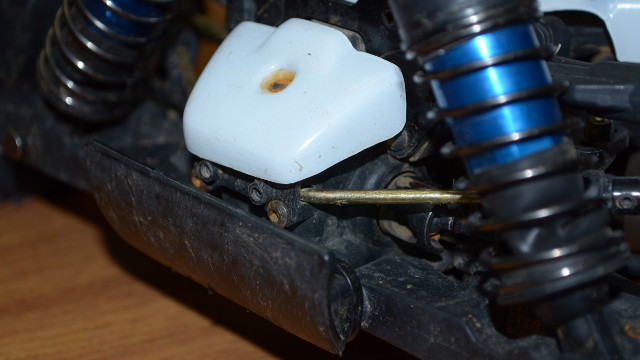
the anti-sway bars, or stabilizers, around. For some reason that I can not fathom, Team Associated has decided that
the stiffer stabilizer should be mounted on the rear. This goes against everything I have know
about racing and vehicle physics, both in the RC world and in the "full scale" real automotive world.
I left the anti-sway bars the way the were when I first purchased the vehicle.
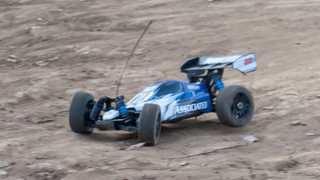
The body roll I experienced in hard cornering was quite severe with the stiffer bar in the rear. The car
very visibly leaned to one side in a corner. However, after swapping the stiffer bar (the gold one, as
Associated colour-codes their sway bars) of the rear into the front and vice versa, the body roll was virtually
eliminated. Instead of leaning to one side, the model simply squats low to the ground, almost level. This
is how a race car should handle.
|
|
Other things that greatly effect handling include your rear toe setting and also the weight of the oil you fill your differentials with. I personally prefer something closer to rear-wheel drive, and out of the box this buggy handles closer to a front-wheel drive car. Out of the box, this buggy contains 5,000cst oil in all three differential, and the rear D-plate is fixed to 3º toe-in. To fix this, I have found the following so far to be helpful:
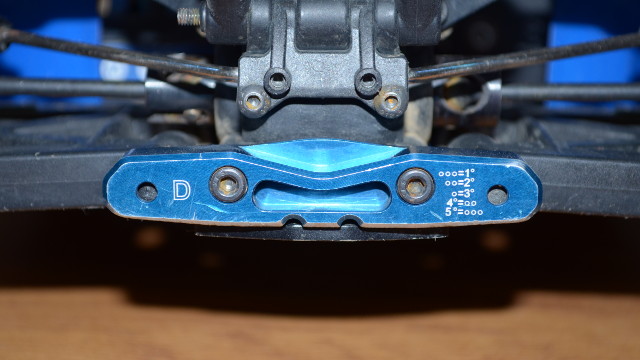
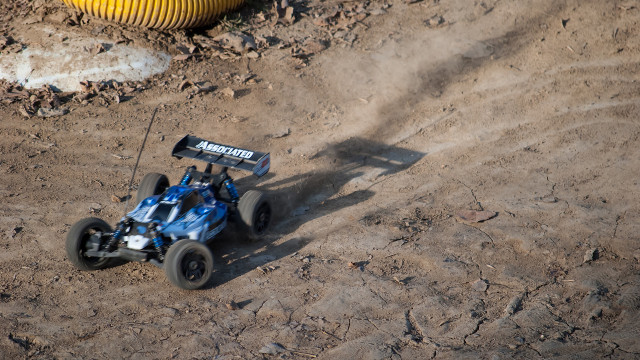
The heavier oil in the center will cause the model to be closer to true all-wheel drive, while the lighter oil in the rear will help keep the rear tires from pushing the car straight through turns and causing understeer. This combinations will invite the rear end to swing out on turns, allowing drifting to become much easier.
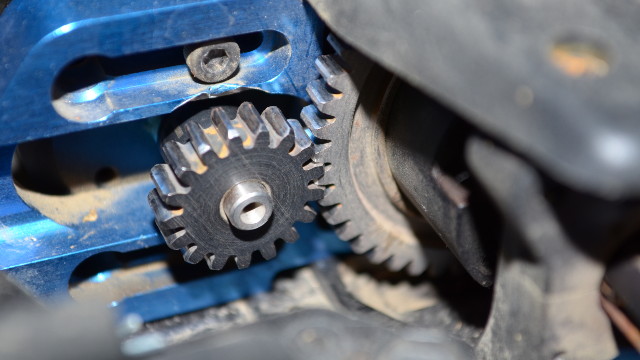
Lastly, I personally recommend for the sake of convenience investing in a steel spur gear. The stock plastic one is much lighter and will spool up faster, giving you greater acceleration than the steel will, so if winning is singularly the most important thing, you may ignore me in this paragraph. However, if you dislike cleaning up leaked silicone oil from the chassis of your model all the time, this may be for you. The difference in acceleration is certainly noticeable to one whom knows his vehicle, but it is overall quite minor, and the trade-off, in my opinion, is well worth it. Since i have installed a steel spur gear, I have not had any oil leaks from the center differential. Besides, your front and rear differentials are steel already, so why did Associated give us just plastic on the center? There is one more thing to be aware of before purchasing, however. I believe this to be irrelevent, but others seem to believe it to be a deal-killer, and that is the noise. The steel-on-steel noise of the pinion on spur really screams. Your differentials have their gear mesh at an angle, eliminating most noise, but the pinion/spur mesh is straight vertical. So much like reverse in a real stickshift, a steel spur gear will really whine at high speed.