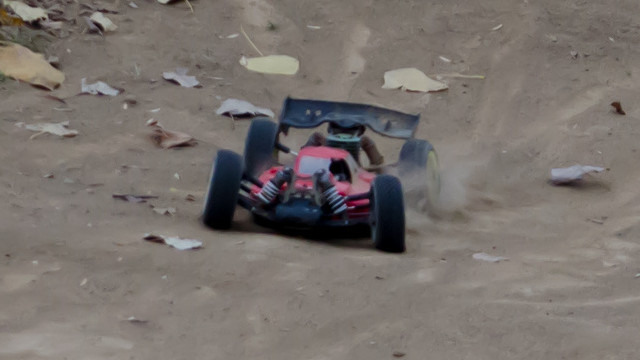
You may find basic tuning information here regarding what tuning options
do and how to fix minor handling characteristics that may not perfectly match your driving style or
track conditions.
To get started with tuning, you may want to prepare yourself with
these basic tools that will cover most adjustments on most models:
- Hex bit set or Allen wrenches, metric, 1.5 - 3.0mm
- Small metric nut drivers (5.5mm is an important one to have for the RC8)
- Small metric wrenches (for where nut drivers can't reach)
And you may also find it useful to have these around for maintenance or more advanced tuning:
- Damper (or shock) oils; weights between 25 and 50 should do for most
- Differential fluids
- Tire glue (Super glue works great)
- Isopropyl alcohol, for cleaning (Not the car body)
Tuning - Cause and Effect
Dampers/Springs
- Stiff springs
- Well suited to smooth surfaces, stiffer spring rates will make the vehicle
more responsive, and also improve it's jump capability by making it harder to bottom out from weight
transfer while approaching the crest of a jump.
- Soft springs
- Soft springs are suited to terrain with many small, mild bumps. Low spring rate
help prevent the vehicle from bouncing too much and provide a more stable ride across washboard
conditions.
- Heavy damper
- Thicker oil or smaller piston holes will make damping heavier. This makes the
model more stable and is the largest factor in preventing the chassis from hitting the ground upon
landing a jump. If it is too heavy, the dampers can not react quickly enough to bumps resulting in a
rough, unpredictable ride.
- Light damper
- Thin oil and large holed pistons result in a more 'springy' feel. This is better
for bumpy sections, or if you need the model to set the body roll quicker for handling on high traction
surfaces.
Tuning - Basic How-to
Change Damper Oil
Here is a generic step-by-step guide to changing the oil in your dampers. This will work for most models.
- Remove top and bottom bolts from damper assembly. These are normally 2 or 2.5mm.
- With damper in hand, the spring retainer can be lifted up off of the end link,
then pulled to the side to free the spring from the damper.
- Next, unscrew the cap from the top of the damper body. This should be doable by hand.
- Once removed, make sure you keep the rubber bladder clean. This normally stays in the cap, but
will frequently stay on the damper body.
- Dump the spent silicone oil into a container or mass of paper towels for disposal. This stuff
is pretty nasty, so I recommend gloves for the rest of the process. Exercise the piston a few
while inverted to remove as much old oil as possible.
- If the seals in the bottom of the damper look fine, simply refill with your choice of silicone
oil weight to about 1/8 of an inch from the top of the damper body.
- Slowly exercise the piston in the oil to free any trapped air.
- Make sure oil level is still 1/8" from the top, put bladder neatly and fully into the cap, and
reassemble everything the same way you took it apart.
- Congratulations, you now have a fresh damper.